

Have You Seen These Yet?


Hey there! I’m Pamela. Just a woman who has fallen in love with getting lost around the world. I’ve traveled to 42 countries across 7 continents.
My mission? To inspire you to ‘let the bucket list flow’ and see what the world has to offer.
My promise: All of my photos are not edited. What you see is what you get.
Join our small-group Tour to Uganda 2027!
- Get up close to gorillas and chimpanzees with trekking!
- See the big 5 Safari Animals
- Learn about Uganda’s culture through local community visits
Capital Cities book

- Discover the world through this 258 page book covering 118 cities
- 3 photos by me!
- Perfect as a gift or for your coffee table
Visiting Abu Simbel in Egypt
Egypt, Africa / November 5, 2025 / 10 comments
Perched on the banks of Lake Nasser in southern Egypt, the Abu Simbel Temples stand as a breathtaking testament to ancient Egyptian ingenuity, artistry, and power. Carved directly into a sandstone cliff over 3,000 years ago during the reign of Pharaoh Ramesses II, these monumental temples were designed to inspire awe in all who approached them. Honestly, I never heard of them until I saw the itinerary! The colossal statues guarding the entrance, each towering more than 60 feet tall, seem to gaze eternally across the desert, a reminder of both human ambition and divine reverence. Visiting Abu Simbel is more than just a journey into Egypt’s past—it’s an encounter with history that continues to defy time and nature.
What makes Abu Simbel even more fascinating is its modern story of survival. In the 1960s, when the construction of the Aswan High Dam threatened to submerge it beneath the waters of the newly formed Lake Nasser, an international effort led by UNESCO successfully relocated the entire complex to higher ground—an extraordinary feat of preservation that mirrored the scale of the original builders. Today, travelers making the trek to Abu Simbel can marvel not only at its ancient majesty but also at the enduring global commitment to protect humanity’s shared heritage.
If you like this post, be sure to sign up for my e-mail list for travel inspiration & tips, or connect with me on Facebook, Instagram, Twitter, BlueSky, Threads, or Pinterest. I also have a Facebook group where you can ask me anything travel related – and I share travel deals!
This post contains affiliate links, meaning if you purchase something I may make a small commission at no cost to you.
Plan Your Trip to Egypt

The temples, located in southern Egypt near Sudan, were built in the 13th Century as a lasting monument to the king Pharaoh Ramesses II and his queen Nefertari. The temples also commemorate his victory at the battle of Kadesh in 1274 BCE. Ramesses chose the site near the Sudanese border because it was already sacred to Hathor, goddess of motherhood, joy, and love. This act only strengthened his divinity in the eyes of his people.
Fun Fact: Ramses II ruled for 66 years, fathered over 160 children, and fought many major battles.
Construction of the temple was completed around 1244 BC, but over time, the temples fell into disuse. Sand, ever-present in Egypt, began to cover the temple and by the 6th century BC the statues were covered to their knees. It wasn’t until 1813 when Jean-Louis Burckhardt, a Swiss orientalist, found the top of the temple. Legend has it, he was guided to it by a boy named Abu Simbel, and so named it after him. Burckhardt discussed his findings with Italian explorer Giovanni Belzoni who was able to finally enter the complex in 1817. It has been admired by anthropologists, historians, and tourists alike since.

How to get to Abu Simbel
To get to Abu Simbel, you can either fly or travel by bus from Aswan. Since you need to be a licensed operator to get through security checkpoints, you can’t simply rent a car and do the drive yourself. Our bus left bright and early at 3:30 am and was a three-hour drive to the temple. It’s a boring ride with deserts all around, be sure to bring a pillow for the bus! However, if it’s going to be a particularly hot day, you may get lucky and see a mirage.

Food for thought: The definition of a mirage is an optical illusion caused by atmospheric conditions or something that appears real or possible but is not in fact so. If a mirage is a trick of the eye, how did I catch it on camera? 😉


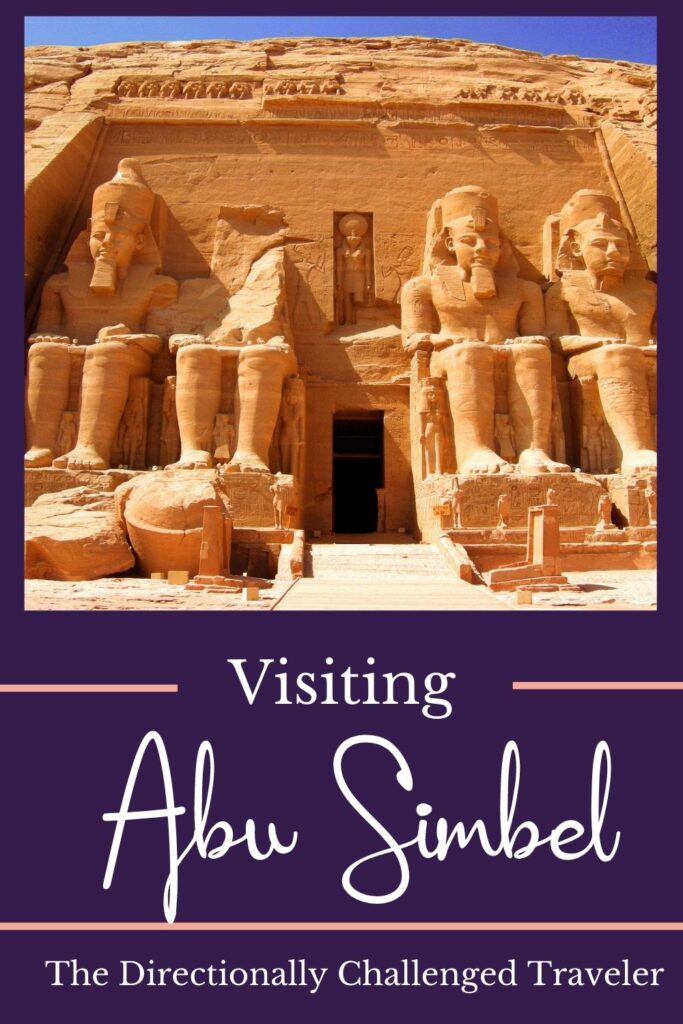
Upon arrival at Abu Simbel, you’ll see the back of the temple first and the water of the Nile ahead of you. Once you round the bend, you can’t miss the four colossal statues, towering at over 65 feet (20m), representing Ramesses II, at different ages, seated on a throne.The statues are not the same but depict Ramesses II throughout his life. The one on the immediate left of the entrance was damaged in an earthquake and rather than restoring them during the relocation, they were placed at the feet in the positions originally found. Beneath these massive figures are smaller statues (still larger than life-sized) depicting Ramesses’ enemies – the Nubians, Libyans, and Hittites.

Travel Tip: Guides are not allowed in the temple. This helps prevent tours from clogging up the entranceway. Guides will give you the history outside of the temple and tell you to keep an eye out for some things inside.


While the temple survived through ancient times and the trials of mother nature, it was threatened by modern progress in the 1960’s. When the decision to create the Aswan High Dam was made in the early 1960’s, researchers realized the temples would be flooded. The entire complex was relocated in 1968 to prevent the temple from being submerged during the creation of Lake Nasser. Lake Nasser is the massive water reservoir that was formed after building the Aswan High Dam on the Nile. The temples were dismantled and relocated about 200 feet (64m) above and 600 feet (180m) west of their original site. You can still see where the temple was made into blocks to be moved if you look closely.
Moving the complex has gone down as one of history’s greatest archeological engineering challenges. You have to look very closely at the rocks to see how they were taken apart and reassembled – it’s nearly perfect.

Everywhere you look at Abu Simbel, there is something grandiose. It can be difficult to wrap your head around the ability to create these temples with such detail without the technology that we have today.

Fortunately, they have recently (as of 2019) started to allow people to take photos within the temple. You have to pay 300 Egyptian pounds for a ticket to do so. The ticket can be split within a couple you just have to take photos one at a time, otherwise, the guards will yell at you.

Once you pass through the entrance, there are engravings showing Ramesses and Nefertari paying homage to the gods. On the north wall is a detailed story of the victory at Kadesh.
The smaller temple nearby has six colossi in the front facade – four which are the king, two are Queen Nefertari. This is a unique ode to the queen, typically women are represented on a much smaller scale than the Pharaoh. Nerfertari’s tomb is not in Abu Simbel, but rather in the Valley of the Queens.

Today, Abu Simbel is the most visited ancient site Egypt after the Great Pyramids of Giza, and for good reason. I was truly impressed with not only the size, but the engineering that went into the temple – both when it was built and when it was moved – as well. Stepping into the temple is like stepping back in time. This is probably the top reason why I will always recommend visiting Abu Simbel. While you’re there, put the camera down, lift your head up, and embrace ancient Egypt and all its glory.
Pin "Visiting Abu Simbel" for Later


About the Author

Read More About Egypt



10 responses to “Visiting Abu Simbel in Egypt”
-

Egypt is such a fascinating place with its history and architecture belonging to another era somehow. Lovely post – I enjoyed the facts and pics a lot.
-

I absolutely loved visiting Abu Simbel. It was a childhood dream come true! I don’t think I saw a mirage so that’s quite special to capture. The guide that I went with definitely didn’t give us this much information so thanks for giving more background on the site 🙂
-

Awesome post! It is incredible how big and stunning this ancient site is. Great tips and that is so cool that you caught a mirage! I can’t wait to see this for myself one day. 😁
-

I love ancient Egyptian history and this is giving me serious wanderlust! So jealous you got to visit this incredible site.
-

This looks incredible. I’ve always wanted to go to Egypt. The history is something I’ve been fascinated by since I was a kid. Loved looking at your photos and some helpful info here for when I finally get myself there
-

Abu Simbel looks amazing! Egypt high on my bucket list and I will definitely be saving this post for my future trip!
-

So much history and beauty in one place. I would love to visit one day. Thank you for sharing!
-

If you asked me where this place was I couldn’t have told you, but I have definitely seen the images!
-

haha I think I would be the same way!
-
-

Thanks for sharing, such a treat I would love to be able to witness this and go to Egypt hopefully one day…
Leave a Reply to SHANY Cancel reply