

What Happened When I Made Kimchi for the First Time in South Korea
South Korea, Asia / November 2, 2026 / Be the first to comment
The smell hits you before anything else.
It’s sharp and earthy, with a warmth that creeps into the back of your throat before you’ve even touched a thing. Standing in a teaching kitchen in Jeonju, South Korea, apron tied, sleeves rolled up, I inhaled deeply and thought: I have absolutely no idea what I’m doing here.
I had never eaten kimchi before. Not once. And somehow, I had ended up in one of South Korea’s most beloved food cities, about to make it from scratch under the watchful eye of a kimchi master (which I didn’t even know existed).
What happened next changed the way I think about food, travel, and the stories that live inside both.
This post contains affiliate links. This means if you purchase something from a link, I may make a small commission, at no cost to you. This helps me keep the site running and free.
If you like this post, be sure to sign up for my e-mail list for travel inspiration & tips, or connect with me on Facebook, Instagram, Twitter, BlueSky, Threads, or Pinterest. I also have a Facebook group where you can ask me anything travel related – and I share travel deals!
How I Ended Up Here
It started, as so many good decisions do, with a leap of faith.
I applied for a FAM (familiarization) trip with Intrepid. These trips are designed to teach travel advisors about the country & the company so we can better assist our clients (aka – you). Our itinerary blended the South Korea Real Food Adventure and the Premium South Korea tours into an eight-day, round-trip journey from Seoul, built entirely around food. Not restaurant lists or Michelin stars, but real, hands-in-the-bowl, fresh meat-on-the-grill food. Small groups of no more than twelve people, a local leader who knew every alley, and an itinerary that treated eating as the lens for understanding an entire culture.
That philosophy was what sold me. I wasn’t looking for a highlight reel. I was looking for something that felt true — something I couldn’t get from a guidebook or a Google Maps review. Intrepid promised exactly that, and from the moment our group gathered in Seoul, it delivered.
The trip wove through markets, street stalls, family-run restaurants, and cooking demonstrations. Every meal is intentional. Every bite comes with context. But nothing — nothing — prepared me for what was waiting in Jeonju.
A City That Lives Slowly
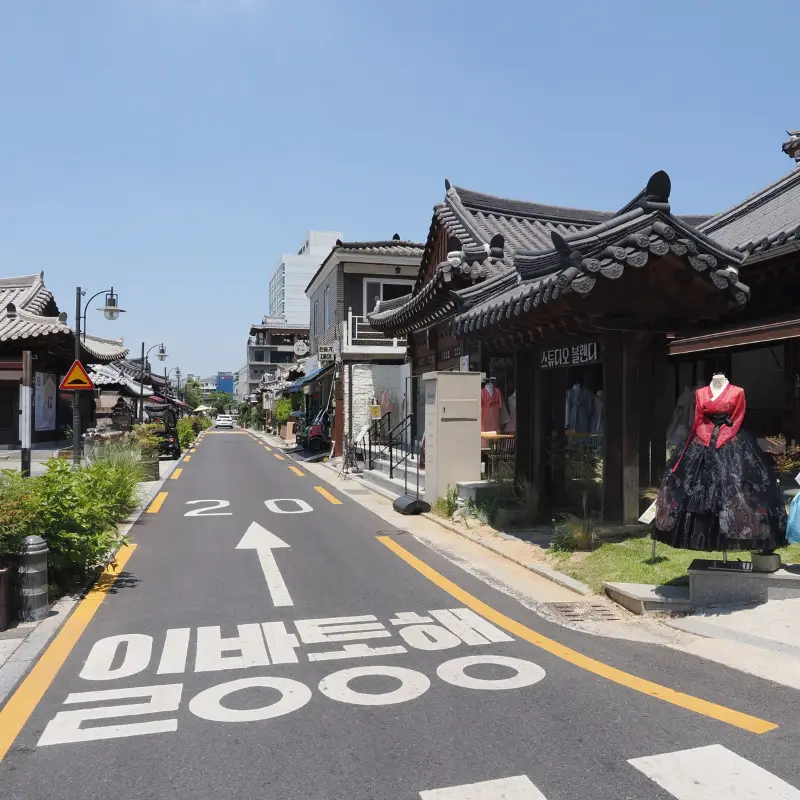
We drove my Gyeong-Ju to Jeonju, which took about three hours. Stepping out of our van and into Jeonju Hanok Village, I felt the city ask me to slow down. The streets are narrow and cobblestoned, lined with the curved tiled rooftops of traditional hanok houses that have stood for centuries. There are no skyscrapers competing for your attention here — just the soft geometry of old architecture and the smell of something good cooking somewhere nearby.
Jeonju is widely considered the food capital of South Korea, and it wears that title with quiet pride. The city doesn’t shout about its culinary legacy. It simply lives it in every kitchen, every market stall, every grandmother who has made the same dish for sixty years without ever writing down the recipe.
Walking through those streets, it struck me that Jeonju and kimchi are a perfect match. Both are unhurried. Both reward patience. Both are far more complex than they appear on the surface.
Meeting the Kimchi Master
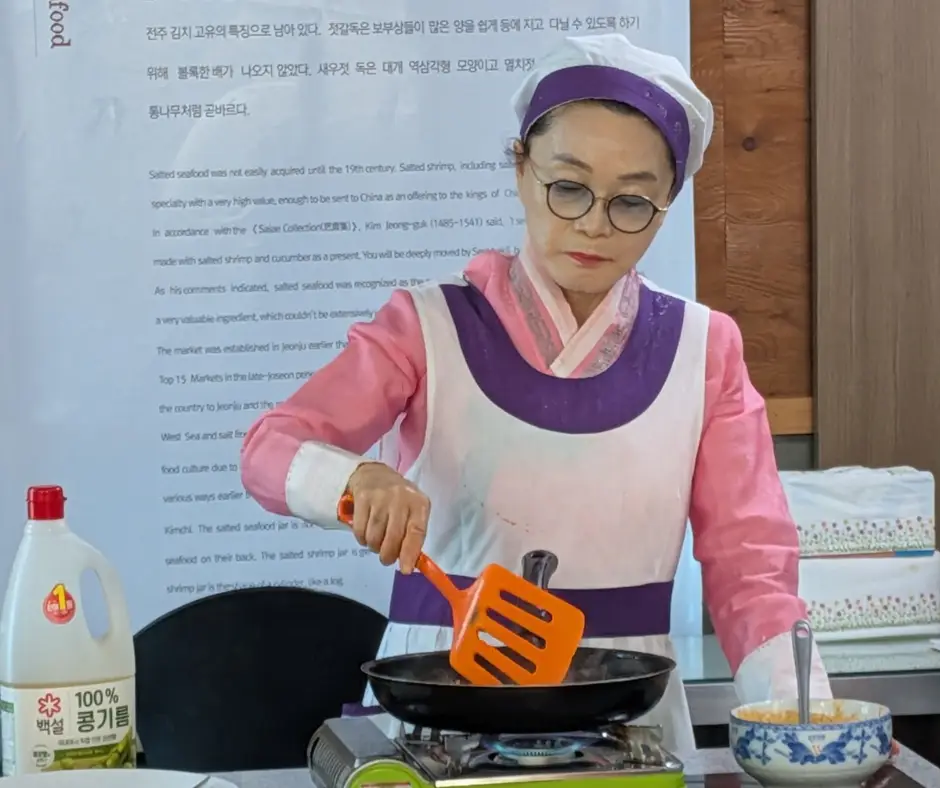
The demonstration space was tucked inside a traditional building just off the main village path. It was simple, warm, and smelled extraordinary — layers of fermented depth that I couldn’t yet name but somehow already trusted.
Our kimchi master moved through the space with a quiet authority that didn’t need to announce itself. She had been making kimchi her entire life — not as a hobby, not as a profession, but as a practice. A cultural inheritance passed from her mother, who learned from hers, stretching back through generations.
Through our guide’s translation, she explained that in Korea, kimchi is not simply food. It is a philosophy. It is kimjang — the communal tradition of making kimchi together before winter — which UNESCO recognized as an Intangible Cultural Heritage of Humanity in 2013. Every family has its own recipe, ratios, and secrets. Sharing your kimchi method with someone is, in a way, sharing a piece of your lineage.
I stood there holding my apron strings and suddenly felt the weight of what we were about to do. I was both humbled and quietly terrified (what if I didn’t like kimchi?!).
Getting My Hands In It
Making kimchi isn’t glamorous. Let me just say that upfront.
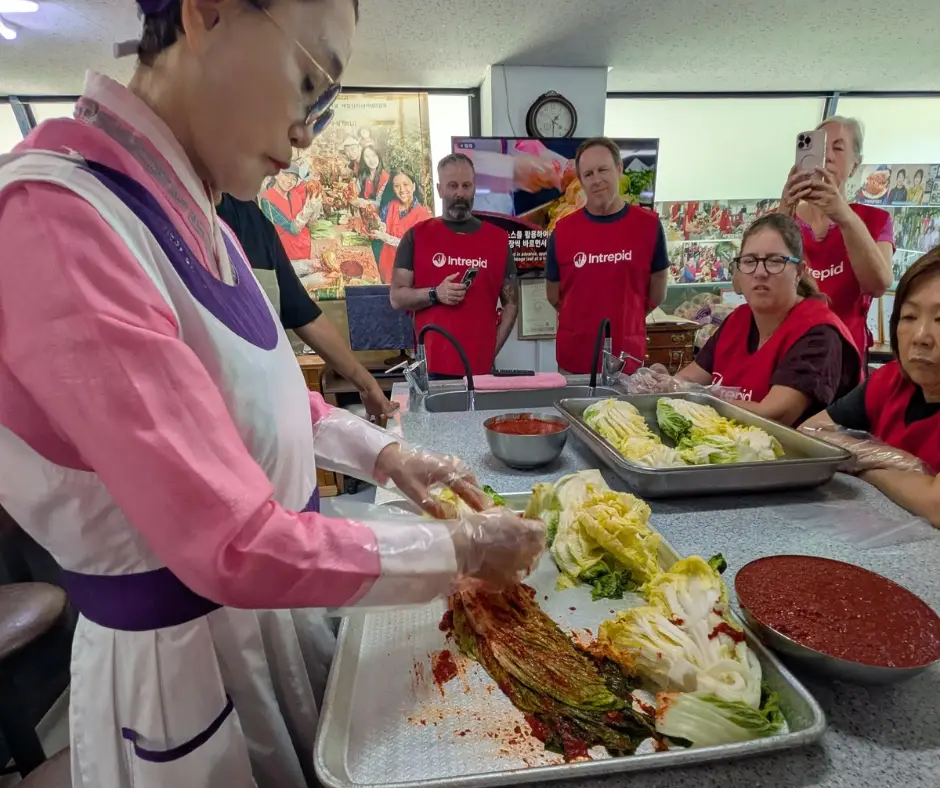
We started with the napa cabbage — baechu — which had already been quartered and was waiting in large bowls. The first step was salting: pressing handfuls of coarse salt between each leaf, working it in by hand until the cabbage began to soften and release its water. It’s physical work. This was done by the master before we got there so the cabbage was ready for the paste.
Gochugaru — the deep red Korean chili flakes that give kimchi its fire — combined with fish sauce, minced garlic, grated ginger, and sliced green onions into something that looked almost alarmingly red. The smell was immediate, aggressive, and wonderful. The master demonstrated the ratio with the ease of someone who has never needed to measure anything in her life.
And then she gestured for us to put our hands in.
No spoons. Hands. (yes, we had gloves, it’s basic food safety!)
I want to be honest: the first thirty seconds were uncomfortable. The paste was squishy; even with the gloves, you could feel the texture. With how strong the smell was, I’m glad we had the gloves. I would not want this chili working its way into every tiny crack in my skin. As someone who has had lemon juice on a paper cut, I’d rather not relive that sting.
But then something shifted. Once you surrender to it, there’s something deeply satisfying about working that paste into every fold of every cabbage leaf by hand. You can feel when it’s right. Within minutes, you develop an instinct for it. The master moved between us, adjusting a wrist angle here, adding a pinch more gochugaru there, offering corrections so gentle they barely registered as corrections.
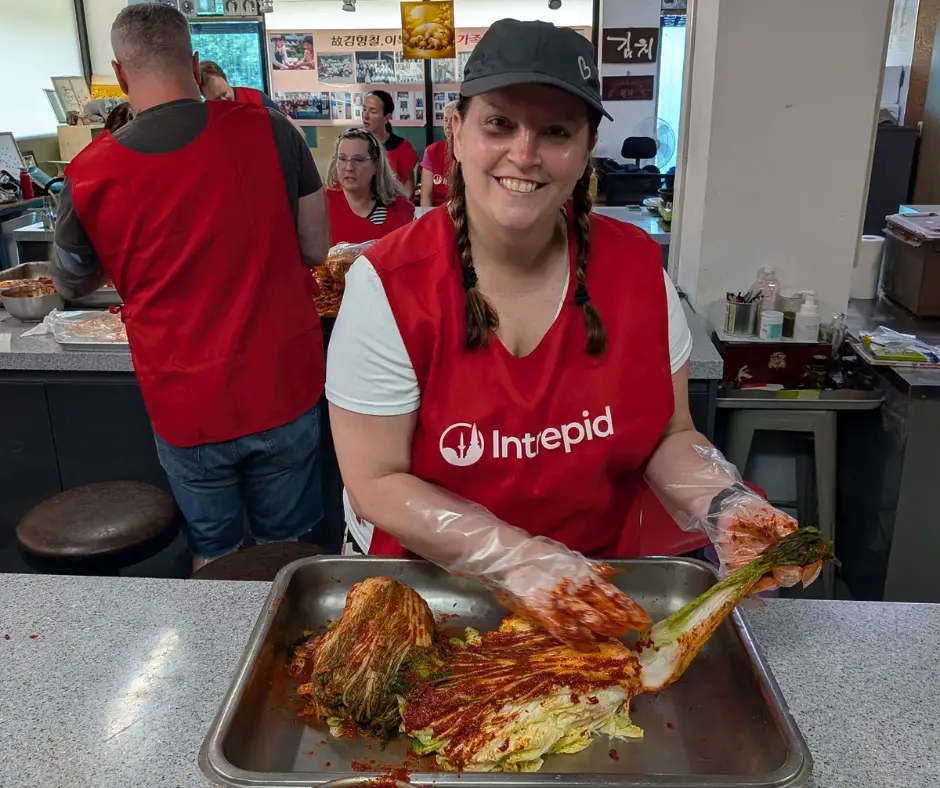
I made mistakes. We all did. And we laughed — with each other, with our guide, with the master herself, who didn’t need a shared language to find us funny and endearing. By the time we mixed our kimchi, my gloves were stained a deep, triumphant red, and I was grinning like I’d accomplished something genuinely impressive.
The First Taste
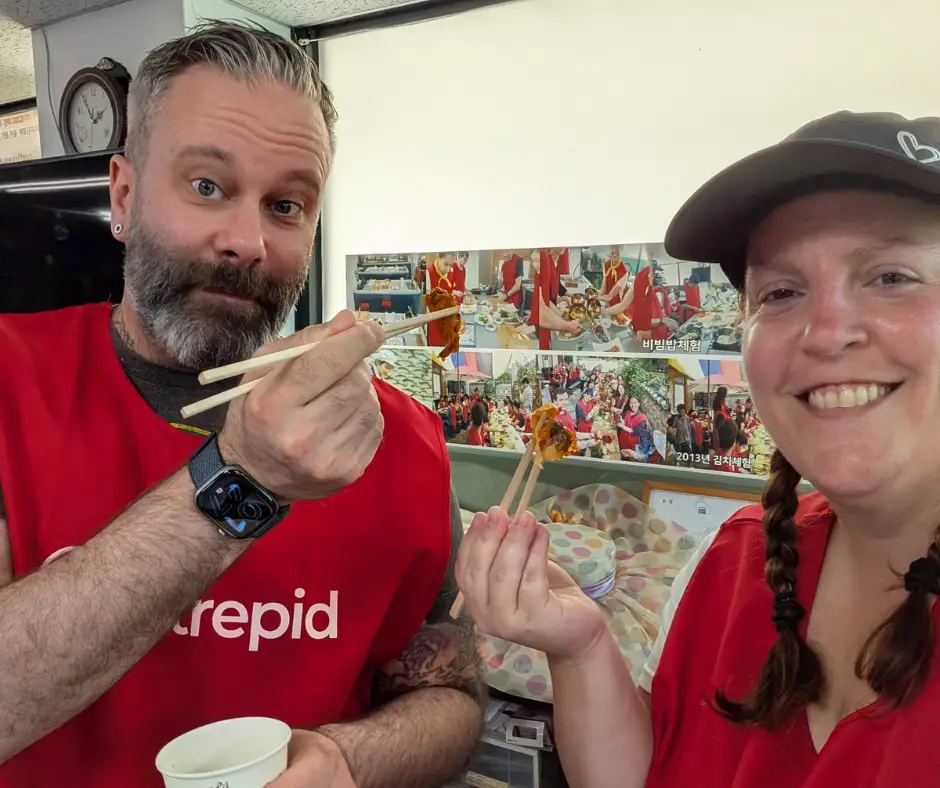
Here is what nobody tells you about kimchi when you’ve never had it: it is not one flavor. It is a conversation between flavors. The master handed me a small piece, and I ate it. Just like that —no ceremony, no bracing myself—I ate it.
The first thing I tasted was the salt. Then the heat, building slowly from the back of my throat (which I wasn’t a fan of). Then something sour and alive, something I would later understand as the beginning of fermentation. Then, underneath all of it, a deep savory richness — umami in its most primal form.
I stood very still for a moment. Then I asked for more.
The master laughed — a real, delighted laugh — and offered another piece. She explained that what I was tasting was geotjeori — fresh kimchi, unfermented, bright and sharp. As it sits and ferments over days and weeks, the flavors mellow, deepen, and transform into something entirely different. The kimchi you eat on day one is not the kimchi you eat on day thirty.
She then made kimchijeon — kimchi pancakes — pan-fried until golden and crisp at the edges. If you are a first-timer who finds the raw intensity of kimchi a little confrontational, kimchijeon is your gentle on-ramp. The heat softens. The tang mellows. What you’re left with is crispy, savory, and frankly one of the best things I have ever put in my mouth.
I was sad I had to share the pancakes with the group.
What I Took Home
Long after leaving Jeonju, the experience stayed with me — fermenting quietly, deepening in meaning the same way the kimchi itself deepens in a jar over time.
Because that’s the thing about food-first travel. You don’t just learn a recipe. You learn a way of seeing. Standing in that kitchen, hands red with gochugaru, laughing with strangers over a shared mess of cabbage and paste, I understood something about Korean culture that no museum exhibit or historical placard could have taught me. Food here is not separate from identity — it is identity. It is community, memory, resilience, and love, pressed between cabbage leaves and left to transform.
Reflection: kimchi is a window into something much larger than itself. It is a window into Korean identity, the slow art of preservation, and the radical idea that some of the most important things in life cannot be rushed.
Intrepid made that possible. Not by handing me an itinerary and pointing me toward the highlights, but by placing me inside the culture — with a local leader who cared, a small group that became friends, and a kimchi master who shared something of herself without needing to share a language.
If you’ve never tried kimchi, try it. If you think you won’t like it — try it anyway. And if you ever get the chance to make it from scratch in a hanok kitchen in Jeonju with someone who has been doing it their whole life, clear your schedule and go.
One Last Thing
Close your eyes for a moment and picture it: an apron around your waist, your hands in gloves stained an impossible red, the smell of garlic and chili thick in the warm air around you, and somewhere nearby, the sound of a group of strangers laughing together over something that is going to become delicious.
That is travel. That is the good kind.
Some of the most meaningful moments I’ve ever had on the road happened not at famous landmarks or viewpoints, but at kitchen tables — or, in this case, at a prep counter in Jeonju, South Korea, learning to make something ancient and alive.
If this sounds like your kind of adventure, Intrepid’s South Korea Real Food Adventure is the real thing. Go hungry. Go curious. Go ready to get your hands dirty. If you’re interest in learning more, set up a FREE call with me and let’s chat!
Have you ever tried kimchi for the first time somewhere unexpected? Drop it in the comments — I’d love to hear your story.
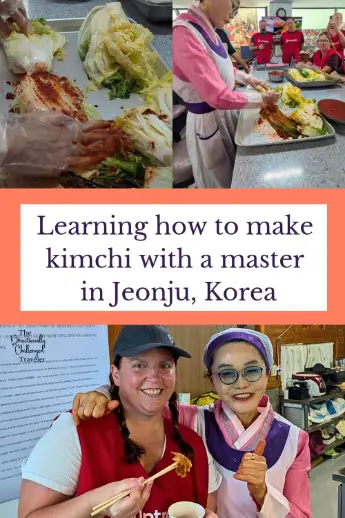
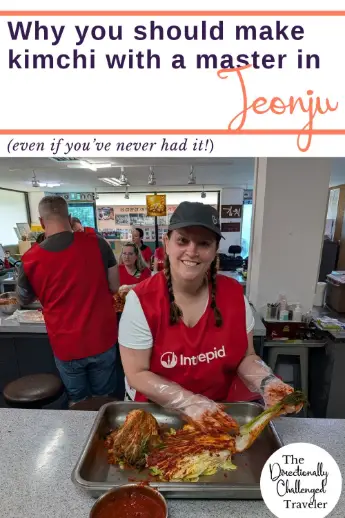
Save “Making Kimchi in South Korea” for Later
About the Author
Read More About South Korea

Have You Seen These Yet?


Hey there! I’m Pamela. Just a woman who has fallen in love with getting lost around the world. I’ve traveled to 42 countries across 7 continents.
My mission? To inspire you to ‘let the bucket list flow’ and see what the world has to offer.
My promise: All of my photos are not edited. What you see is what you get.
Join a small-group safari to Kenya & Uganda!
- Go trekking and get close to gorillas and chimpanzees
- See the big 5 Safari Animals
- See The Great Migration
- Sunrise hot air balloon ride and champagne breakfast included
- Maximum of 12 guests
Capital Cities book
- Discover the world through this 258 page book covering 118 cities
- 3 photos by me!
- Perfect as a gift or for your coffee table
Travel Shop
- Accommodation Comparison Excel
- Printable Bucket Lists
- Travel Planning Resources
- & More!
Leave a Reply